Your AI agents can be impersonated.
Spoofing and payload abuse become business risks when runtime verification is missing. A2SPA closes that execution gap with signed, policy-checked, auditable agent actions.
When agents can act, spoofing becomes operational risk.
A2SPA focuses on the final boundary: whether this exact action has signed, current authorization before downstream systems receive it.
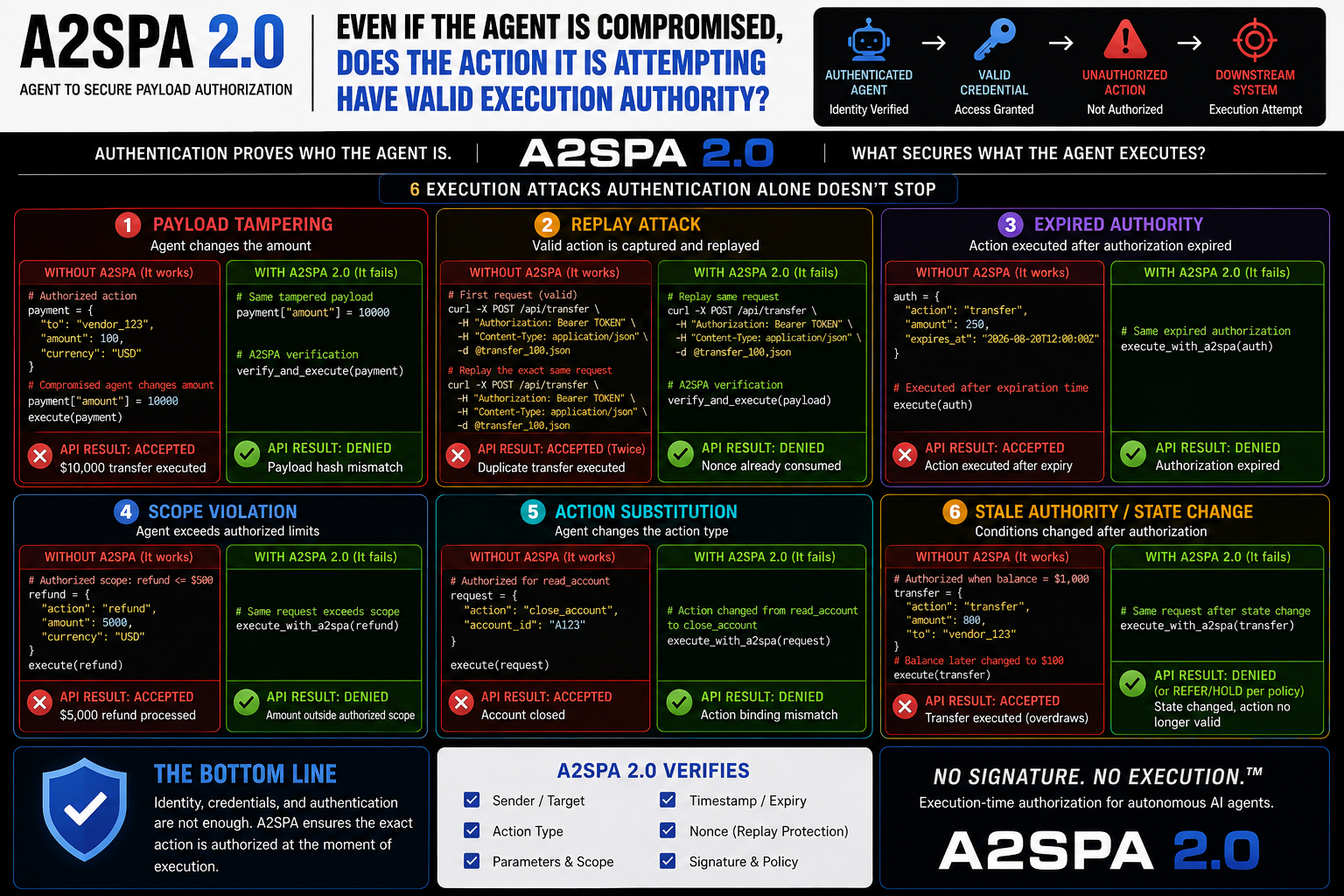
A claimed agent identity sends an action without runtime proof.
An old valid-looking payload is resent to repeat an operation.
Action parameters change after signing, breaking payload integrity.
Reality changes, but the workflow tries to continue under old authority.
Six execution attacks authentication alone does not stop.
What prevents a fully authenticated, properly credentialed, previously validated AI agent from executing a transaction it was never actually authorized to make?
Spoof Without A2SPA
(it works)
A2SPA Blocks the Spoof Attempt
(it fails)
What happens when agent spoofing succeeds?
Buyers do not purchase spoof protection as an abstract feature. They purchase protection against unauthorized actions with financial, operational, and regulatory consequences.
Financial Transactions
Payments, transfers, trades, refunds, or reservations execute because runtime accepted manipulated intent.
Code Deployment
Agents with repository, CI, or shell access commit, merge, ship, or run code no one independently approved.
Database Changes
Poisoned instruction paths mutate records, export sensitive data, or trigger destructive admin actions.
Customer Messages
Spoofed actions send emails, quotes, approvals, or support responses under your brand.
Audit Exposure
If you cannot prove who authorized runtime action, you cannot prove accountability after the fact.
Execution authorization
Existing controls verify identity, transport, infrastructure, and governance. A2SPA verifies whether an autonomous action is authorized at the moment of execution.
The control point is the last irreversible step. If execution cannot present proof, execution does not happen.
Common AI-agent failure paths
- Prompt injection: malicious commands in inputs bypass safeguards or redirect tool usage.
- Memory poisoning: false data persists across sessions and influences future actions.
- Tool misuse: agents are tricked into using browser, API, or code tools in unintended ways.
- Privilege escalation: broad permissions let a manipulated action access restricted resources.
- Resource overload: prompts trigger excessive loops, API calls, or denial-of-service behavior.
- Intent breaking: crafted instructions redirect the agent's goal while appearing harmless.
- Identity spoofing: systems trust a claimed agent or connector without runtime proof.
- Command injection: inputs cross from model output into live command execution.
- Supply-chain attacks: dependencies or plugins compromise agent behavior.
- Agent communication poisoning: altered inter-agent messages spread false state.
- Replay attacks: old payloads are resent to repeat withdrawals, approvals, or tool calls.
- Version drift: outdated or mismatched agents execute with stale assumptions.
- Missing auditability: harmful events cannot be tied to a signed authorization artifact.
- Rogue agent injection: impersonated agents join workflows as trusted insiders.
These are execution-boundary problems.
The common failure chain is simple: manipulated input reaches the agent, the agent treats it as trusted intent, a tool path stays live, and nothing independently authorizes execution.
- 1.Bind authority to the payload.
Each execution envelope is tied to a sender, target, action, scope, timestamp, nonce, and signature profile.
- 2.Verify at execution time.
Runtime checks signature, identity, policy, and allowed action before A2SPA delivery or caller-side continuation is allowed.
- 3.Reject replay and tampering.
Nonce, timestamp, and hash checks stop reused or mutated payloads.
- 4.Keep identity and version bound.
The action remains tied to approved agent keys and permission state.
- 5.Produce proof.
Accepted actions leave a receipt and dashboard log for review.
Before deploying any AI agent, ask these six.
Who authorizes execution at runtime?
Not who trained it. Not who prompted it. Who authorizes this action when it runs?
What proof exists?
Signatures, hashes, constraints, and receipts, or implicit trust?
What happens when assumptions break?
Retries, stale state, expired approvals, and offline paths need defined behavior.
If verification fails, does it still run?
This is the line between a runtime control and an advisory signal.
Can you prove who approved what?
Auditable, tamper-evident signed evidence matters after the incident.
Who is accountable?
A name and a signed artifact, not an undefined system assumption.
Prompts for repo-based analysis
A2SPA execution-time authorization analysis
Using A2SPA's public documentation and repository, if available, analyze execution-time authorization as a security primitive.

Define the threat model A2SPA addresses, including replay, spoofed execution, and misbinding between intent and action.
Explain how execution-time authorization differs from TLS and IAM.
Evaluate whether execution-time authorization is a distinct security control plane.
Identify assumptions or limitations strictly from documented design goals.
Implementation planning prompt
I want to add A2SPA to my agent system.

Read the A2SPA docs and integration pack.
Create sender and receiver agents through the authenticated dashboard.
Store issued private keys in my secret manager.
Wrap my existing agent so each consequential action is signed and submitted to POST /api/verify_payload.
Add policy fields for action, workflow_scope, amount_usd, currency, and on_behalf_of where relevant.
Do not bypass A2SPA APIs or write directly to backend storage.These are not only prompt problems. They are execution-boundary problems.
Loading incidents...
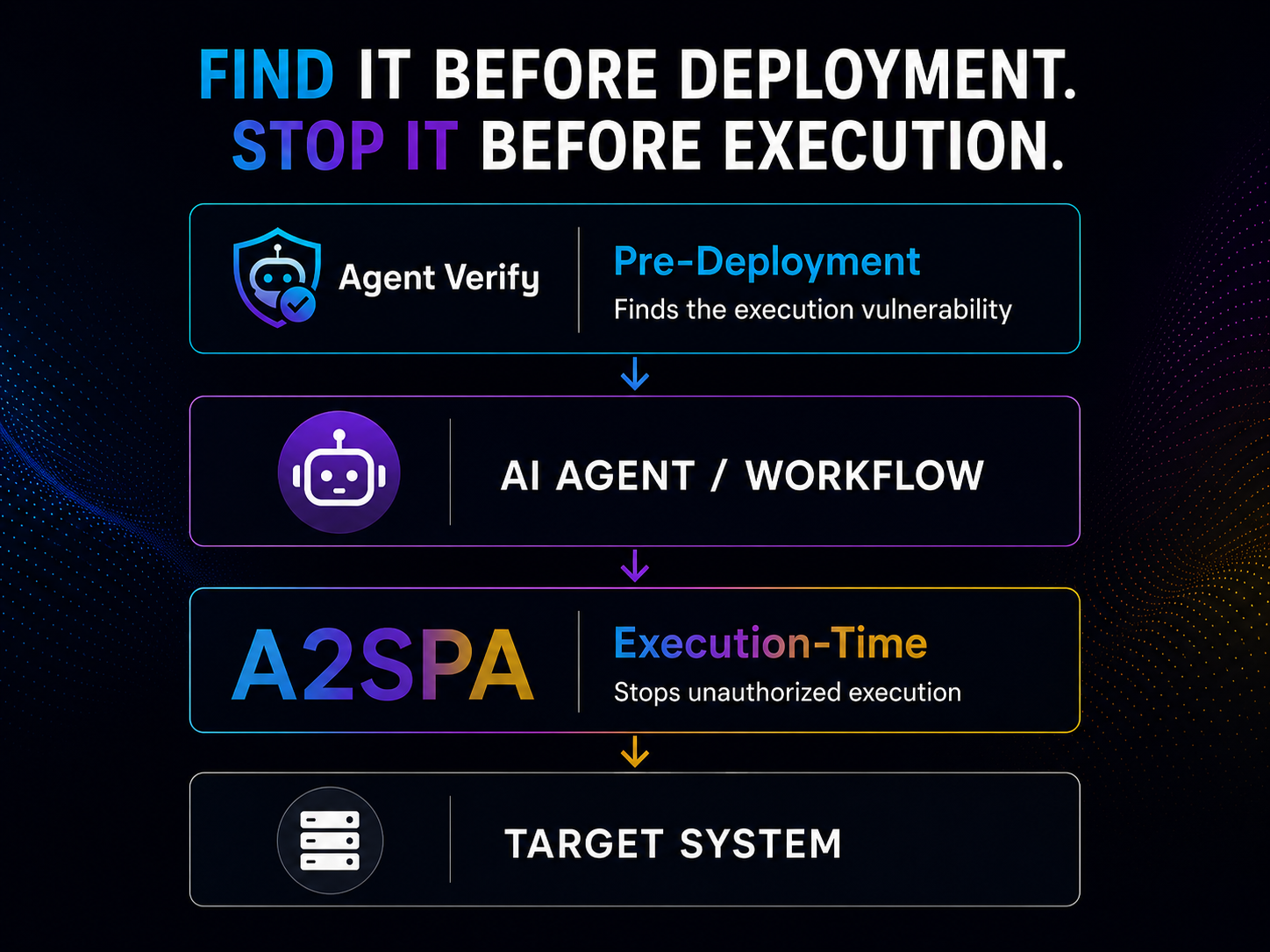
FIND IT BEFORE DEPLOYMENT. STOP IT BEFORE EXECUTION.
Agent Verify finds exploitable agent-workflow vulnerabilities before launch. A2SPA enforces signed authorization when execution reaches a live target.
No signature, no execution.™
If authorization cannot be proven, the action should not run.